

The North Face, from trail to sidewalk
An American outerwear and outdoor-lifestyle brand that has spent years moving between technical gear and everyday city clothing — which is exactly why it belongs in a wardrobe conversation.
A jacket brand that ended up in everyday wardrobes
The North Face started as outdoor equipment and stayed close to that job. What made it interesting to people who never climb anything is that the same design logic — block the weather, leave room to move, pack small — turns out to be useful on a Tuesday commute too.
This profile covers what the brand is known for, how a shell and its mid-layers actually work together, where these pieces fit in a city wardrobe, and what to check before you commit to one. It is written for readers who want one jacket that handles more than one situation.
- Known for
- Jackets, shell layers, and outdoor-inspired streetwear built for weather first.
- Where it fits
- Fall through spring in most of the United States, worn over plain everyday clothes.
- Who it suits
- Anyone whose week includes weather, walking, or both — and wants one piece to cover it.
What the brand is known for
The North Face is best known for jackets, shell layers, and outdoor-inspired streetwear. Its reputation rests on functional outerwear that handles weather, not on fashion novelty. In 2026 the brand continues to rise in US fashion brand consideration rankings, which says something about how much city wardrobes now borrow from outdoor design.
The pieces are designed for conditions first. That order of priorities is what makes them age slowly — a jacket cut for wind and rain does not stop working when a silhouette goes out of season.

Shell layers and mid-layers, in plain terms
Two words get used loosely in outerwear. Getting them straight is the difference between a jacket that works in three seasons and one that only works in one.
A shell is the outer layer that blocks wind and rain without adding warmth on its own. That is what makes it useful: you add insulation underneath when it is cold and remove it when it is not. A shell also packs down small, which matters if your day involves a commute and an unpredictable forecast. Think of it as the roof of your outfit, not the whole house.
Under the shell sits insulation, usually fleece or a synthetic fill. Fleece works for cool, dry days; synthetic fills handle colder, wetter conditions. The mid-layer is where most of your warmth lives, and it should sit close to the body without compressing. Getting this layer right matters more than the jacket you wear over it.
A plain tee or a light knit is enough. The base layer's job is to sit against the skin comfortably and stay thin, so the two layers above it can do their work without the whole outfit reading as bulky.

Outdoor style in a city wardrobe
Outdoor clothing reads as style now because it solves real problems. A shell over denim and a plain tee looks deliberate in a way that a purely decorative jacket does not — the piece has a reason to be there, and that shows.
The key is proportion: keep the layers under the jacket relatively slim so the outer piece does not look inflated. Neutral colors make the crossover easier to pull off, because a dark shell already sits comfortably next to denim, grey knitwear, and plain white cotton.
- Slim knit or plain tee underneath, not a bulky hoodie
- Straight or slim denim, so the hem line stays clean
- One neutral outer color across the whole week
- Boots or a plain sneaker with visible tread
Fit and proportion
Outerwear runs roomier than other clothing by design, which means sizing is a real decision rather than a formality. A shell should leave room for a mid-layer without swimming on you.
Sleeves should reach the wrist when your arms are down, and the hem should sit around the hip. If you plan to layer heavily, size for the layers, not for the label. Trying a jacket on over the thickest knit you own tells you more than any size chart.
There is one more trade-off worth naming: a roomier cut that accommodates layers will look loose over a t-shirt in spring. If most of your wearing happens in mild weather, a trimmer shell worn closer to the body is the more useful choice.
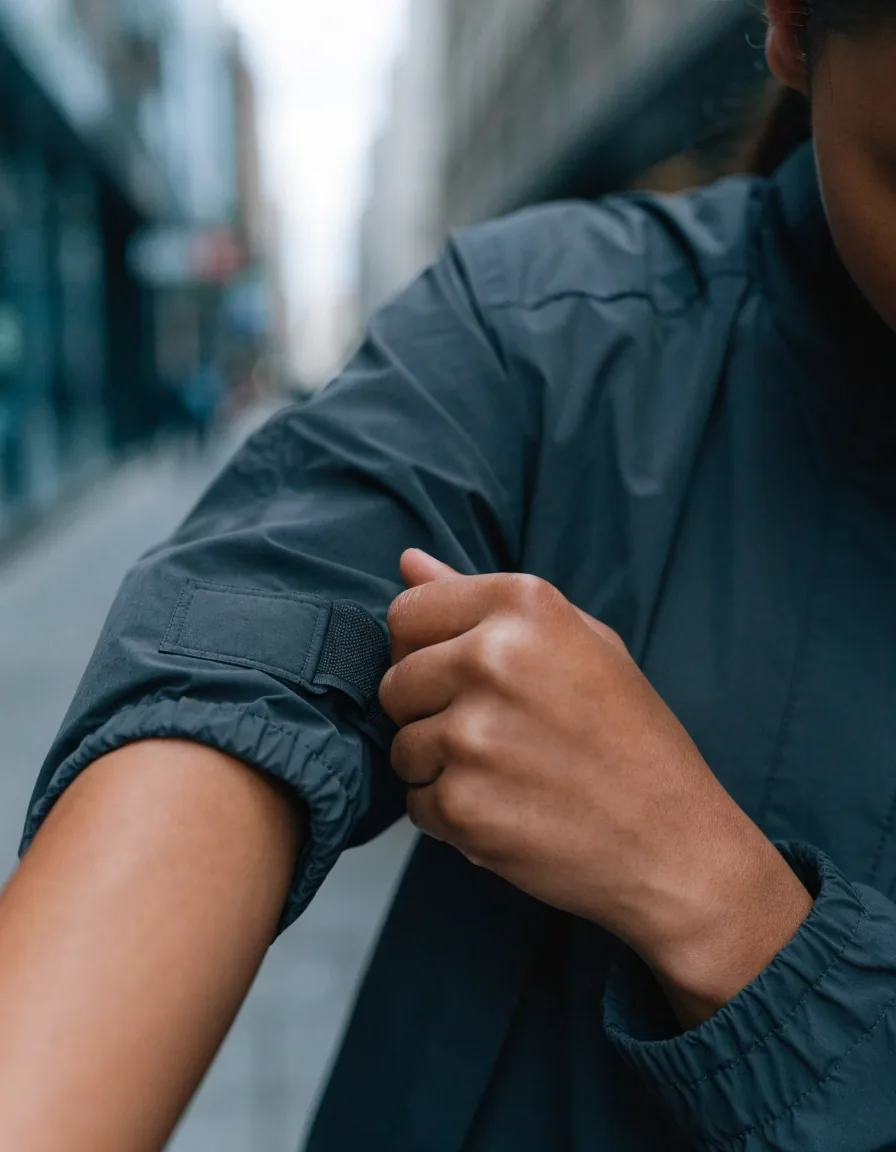
Cuff closure and sleeve length are the first things to check in person
One jacket, three seasons
The same outer layer does different work depending on what you put under it. That range is why one well-chosen piece replaces several single-purpose jackets, and it is a good argument for spending more on the outer layer than on anything else in the rotation.
Shell over a light base
Covers most days from September through November in the northern states. Wind and rain are the problem, not cold, so the shell carries the whole job and the mid-layer stays in the bag.
Add insulation underneath
Fleece for cold and dry, a synthetic fill for cold and wet. The same jacket keeps working; the warmth simply moves to the layer you can take off indoors.
The shell comes back out alone
Warm afternoons and wet mornings in the same week. A thin shell over a tee handles both without you carrying anything extra.
Who it suits
It suits anyone whose week includes weather, walking, or both. It also suits people who want one jacket that works in more than one situation, and who would rather own three good layers than nine thin ones.
If your style is formal, or your climate is mild year-round, the brand's value is lower for you — there is nothing here that a lighter jacket would not do. Honest fit matters more than brand loyalty, and it is worth saying plainly.
What to check before you buy
Five things worth two minutes each. None of them need a salesperson's help.
-
Seams and zipper
These fail first. Run a thumb along the taped seams and zip the main closure all the way up and down once, watching for a catch or a gap where the two sides meet.
-
The hood
Check whether it adjusts and whether it stays up when you turn your head. A hood that only works when you hold it is not doing the job a shell was bought for.
-
Pocket placement
Put your hands in. The pockets should sit where your hands actually fall, not an inch higher, and the openings should close in wind.
-
Room for the layer
Confirm the shell has room for the layer you will actually wear under it. Wear that layer to the store if you can — it is the only test that settles the size question.
-
Care instructions
Technical fabrics have specific washing requirements that are easy to get wrong. Read the label before the first wash, not after it, and follow what it says about heat and detergent.
Questions that come up
Short answers to the things readers ask most about buying and wearing this kind of outerwear.
Do I need a shell if I already own a winter coat?
They solve different problems. A winter coat is one fixed amount of warmth; a shell is a frame you change layers inside. If you walk in shoulder seasons or get caught in rain, the shell earns its place next to the coat rather than instead of it.
Is a shell warm on its own?
No, and that is the point. It blocks wind and rain while the mid-layer holds the warmth. Wearing a shell alone on a cold day is a common mistake — you stay dry and still feel cold, which usually means the layer underneath is the wrong one.
How do I wash technical fabric without ruining it?
Follow the care label on the specific piece — it will name the temperature and whether a machine wash is acceptable at all. Avoid harsh detergent and high heat unless the label says otherwise, and close every zipper and flap before washing so the hardware does not snag the fabric.
Does a roomier fit look sloppy in the city?
Only when the layers underneath are bulky too. Keep the base and mid-layer slim and the outer piece reads as deliberate. Neutral colors do a lot of the work here, because a dark shell next to denim and grey knitwear rarely looks like an accident.
One good outer layer does more than three average ones
If this profile helped you decide what to look for, the next useful step is comparing it against the other brands and outfit guides on the site. If something here reads wrong, tell us — corrections are welcome and we act on them.
Monday–Friday: 9:00 AM – 6:00 PM
Editorial resource — not a store. No orders are taken on this site.